The AI Skills Gap Inside HR Itself: Why Governance Beats Technology

Ninety-two percent of CHROs expect deeper AI adoption in their HR function this year. Over half of organizations haven't implemented any AI in HR yet. That gap between expectation and deployment isn't a technology shortage — SHRM's 2026 research is explicit that skills, governance, and leadership readiness, not the availability of tools, are what's actually holding adoption back.
The gap between expectation and deployment
It would be easy to assume the holdup is that good AI tools for HR don't exist yet. They do. The more accurate explanation is that most organizations haven't built the internal capability to deploy them with confidence — the people who'd need to approve, configure, and monitor an AI rollout in HR often don't yet have the fluency to do that job well.
What's actually blocking adoption
Three things show up repeatedly in the research: skills (most HR teams haven't been trained on how to evaluate or manage an AI system, as distinct from using one), governance (many organizations don't have an HR-specific AI policy at all, relying on a generic company-wide one that doesn't address HR's particular risks), and leadership (without a CHRO or HR leader actively sponsoring the rollout, AI initiatives stall in pilot purgatory). Closing all three is the core of what an HR transformation initiative actually needs to plan for.
Why "just buy the tool" skips the hardest part
A capable AI tool deployed without the governance and internal skill to manage it tends to produce exactly the failure mode leaders are afraid of: inconsistent answers, no clear audit trail, and no reliable way to catch a mistake before an employee sees it. The tool was never the hard part — the organizational readiness around it was.
A safer way to build the muscle before going live
Rather than learning AI governance by trial and error on real employees, some organizations are turning to simulation-based training: practicing AI-assisted HR decisions in a sandboxed environment, including scenario-based legal compliance checks across different jurisdictions, before any of it touches production. It's a closer analogy to a pilot training in a simulator than to learning on a live flight — and it's a more honest way to close the skills gap than assuming the tool will close it on its own.
Sources
Frequently asked questions
Is there really a gap between what CHROs expect and what's deployed?
Yes. SHRM's 2026 research finds 92% of CHROs expect more AI adoption this year, while over half of organizations haven't implemented any AI in HR yet. Expectation is running well ahead of actual deployment.
If the technology exists, why isn't it being deployed faster?
The research points to skills, governance, and leadership gaps as the primary blockers — not the technology itself. Most organizations don't yet have the internal fluency or the approval processes needed to deploy AI in HR workflows with confidence.
Why can't a team just buy an AI tool and skip the skills-building step?
A tool without governance and trained users tends to produce exactly the outcomes leaders fear from AI: inconsistent answers, no audit trail, and no clear path to catch a mistake before it reaches an employee. The tool is necessary but not sufficient.
What's a lower-risk way to build the internal muscle before going live?
Simulation-based training lets an HR team practice AI-assisted decisions and see the outcomes before any of it touches real employees — closer to how pilots train in a simulator before flying, rather than learning on a live flight.
Related reading
Stress-Test Your HR Team Before Reality Does
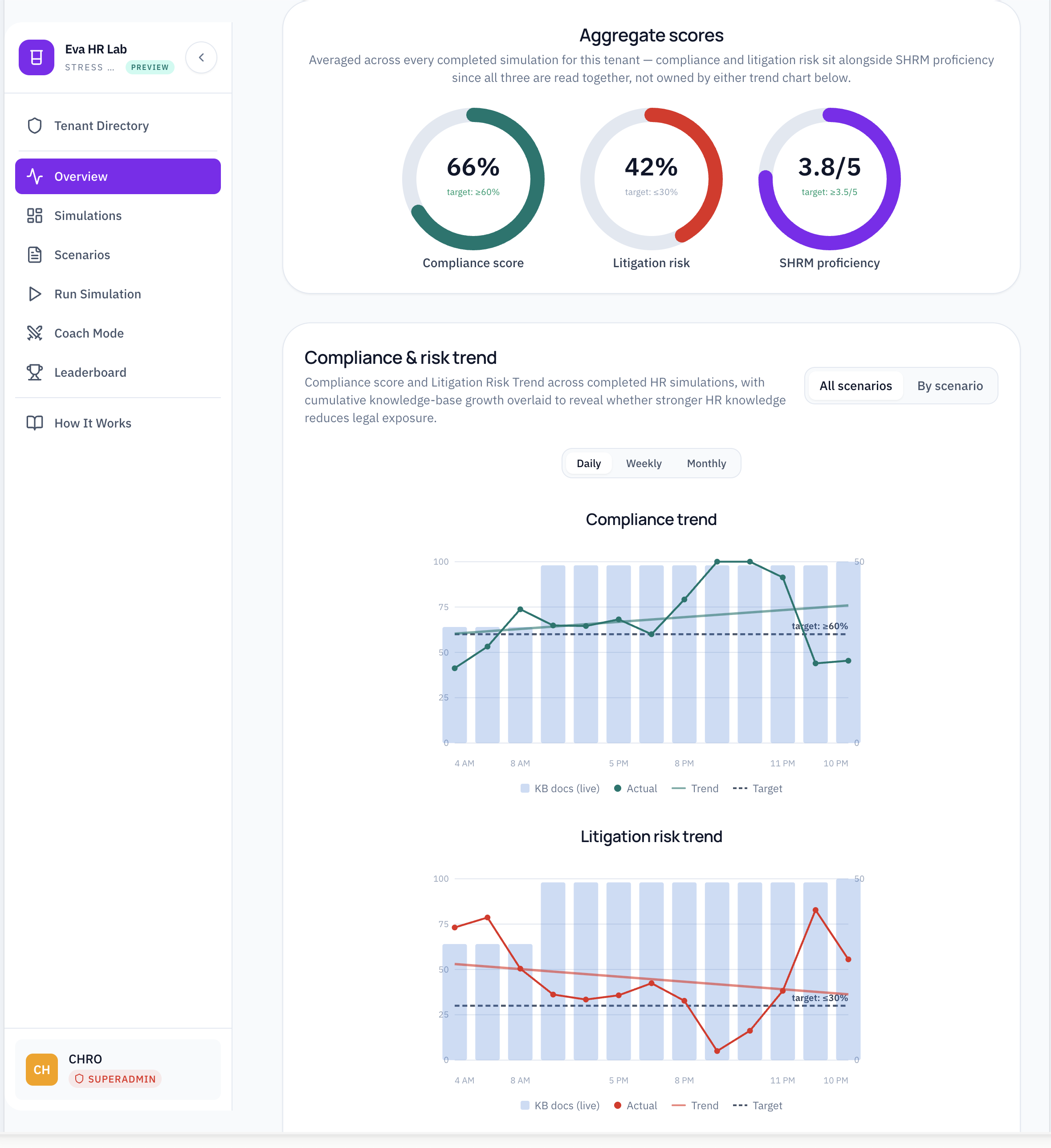
Eva HR Lab runs your organization through scenario-based simulations of the conversations that create litigation risk, and scores your team blind against Eva.

The EU AI Act's High-Risk Rules for HR AI Are Now in Force
The EU AI Act's high-risk obligations for employment AI are now active. Here's what changed for hiring, promotion, and monitoring tools, and what HR needs to check first.
Train your HR team safely before rolling AI into production.
Explore Eva HR Lab