EU Pay Transparency: Your Employees Can Now Ask HR About Pay. Can You Answer Consistently?

Since 7 June 2026, the EU Pay Transparency Directive has given every worker the right to ask about pay. Under Article 7, a worker can request, in writing, their own pay level and the average pay levels by sex for colleagues doing the same work or work of equal value. The employer has two months to answer and must remind every worker of this right once a year (Directive (EU) 2023/970).
Most of the attention has gone to pay-gap reporting. The request right is the part employees will actually use, and it lands on HR service teams.
Where transposition stands
The deadline passed with most of the EU unready. Only Slovakia, Italy, Malta and Lithuania had full national laws in force on 7 June. Greece followed in July, with employer obligations from 1 November 2026. Belgium, Ireland and Poland have partial measures, and roughly ten member states, including Germany, Spain and Sweden, had no published draft as of September 2026 (Morgan Lewis; Syndio tracker).
For a multinational, that means the rules employees are asking about differ by country today and will keep changing as each national law arrives.
Why this is an HR service problem
Commentators describe Article 7 as an operating model rather than a filing exercise (Trusaic; beqom). The annual notice guarantees a recurring wave of questions. Most of them come before anyone files a formal request:
- Am I covered yet in my country?
- What exactly will I receive, and is it anonymous?
- Who do I ask, and how long will it take?
Employees ask these in their own language, and the correct answer depends on where they work. A late or inconsistent reply is more than a bad experience: under the Directive, failing to answer on time and accurately shifts the burden of proof to the employer in a pay discrimination claim.
Where Eva fits, and where it doesn't
Eva doesn't calculate pay gaps, and it doesn't hand out anyone's pay data. That work belongs to your compensation and payroll processes.
What Eva handles is the question volume around them. Eva People answers "how does this work here?" from your approved pay-transparency policy for each country, in the employee's language, with the source cited, and routes the formal request itself to HR. As each country's law changes, you update one approved document and every answer follows.
Eva Insights shows what employees are saying about it. HR sees privacy-preserving trends: which countries are asking most, how volume moves after the annual notice goes out, and which questions your content doesn't answer yet. You get the pattern without exposing anyone's details, which matters on a topic as sensitive as pay.
A short checklist for HR operations
- Publish an approved, country-specific explanation of the request right, even where national law is still pending. Say what applies now.
- Give employees one place to ask and one route for formal requests, with the two-month clock tracked from receipt.
- Plan for a spike of questions after each annual notice.
- Review the questions your content couldn't answer, monthly, and close the gaps before the next notice.
This article is general information, not legal advice. Check national transposition with your employment counsel.
Sources
- Directive (EU) 2023/970, EUR-Lex
- Morgan Lewis, EU Pay Transparency Directive: the deadline for transposition has passed, what now?, June 2026
- Syndio, EU Pay Transparency Directive transposition tracker
- Trusaic, Article 7 right to information: challenges and compliance
- beqom, EU Pay Transparency Directive: the right to request pay information
Frequently asked questions
What does Article 7 of the EU Pay Transparency Directive give employees?
Workers can request, in writing, their own pay level and the average pay levels, broken down by sex, for categories of workers doing the same work or work of equal value. The employer must answer within two months and must tell all workers about this right every year.
When did the Directive take effect?
Member states had to transpose Directive (EU) 2023/970 by 7 June 2026. Only Slovakia, Italy, Malta and Lithuania had full national laws in force by that date. Greece followed in July 2026, with employer obligations from 1 November 2026, and several large member states, including Germany, Spain and Sweden, had not published a draft as of September 2026.
What happens if an employer answers late or inaccurately?
Under the Directive, failing to give a timely and accurate answer shifts the burden of proof to the employer in a pay discrimination claim. Consistency and timeliness of answers are therefore a legal matter, not only a service-quality one. This article is general information, not legal advice.
Can Eva calculate pay gaps or answer individual pay requests?
No. Pay-gap analysis and the individual pay information itself belong to your compensation and payroll processes. Eva People answers the surrounding questions from approved policy (how to make a request, what it covers, when to expect a reply) in the employee's language, and routes the request itself to HR.
How does Eva Insights help with pay transparency?
Eva Insights shows privacy-preserving trends in what employees ask: which countries and teams are raising pay-transparency questions, how volume changes after the annual notice, and which questions your approved content doesn't answer yet. HR sees the pattern without seeing any individual's details.
Related reading
Stress-Test Your HR Team Before Reality Does
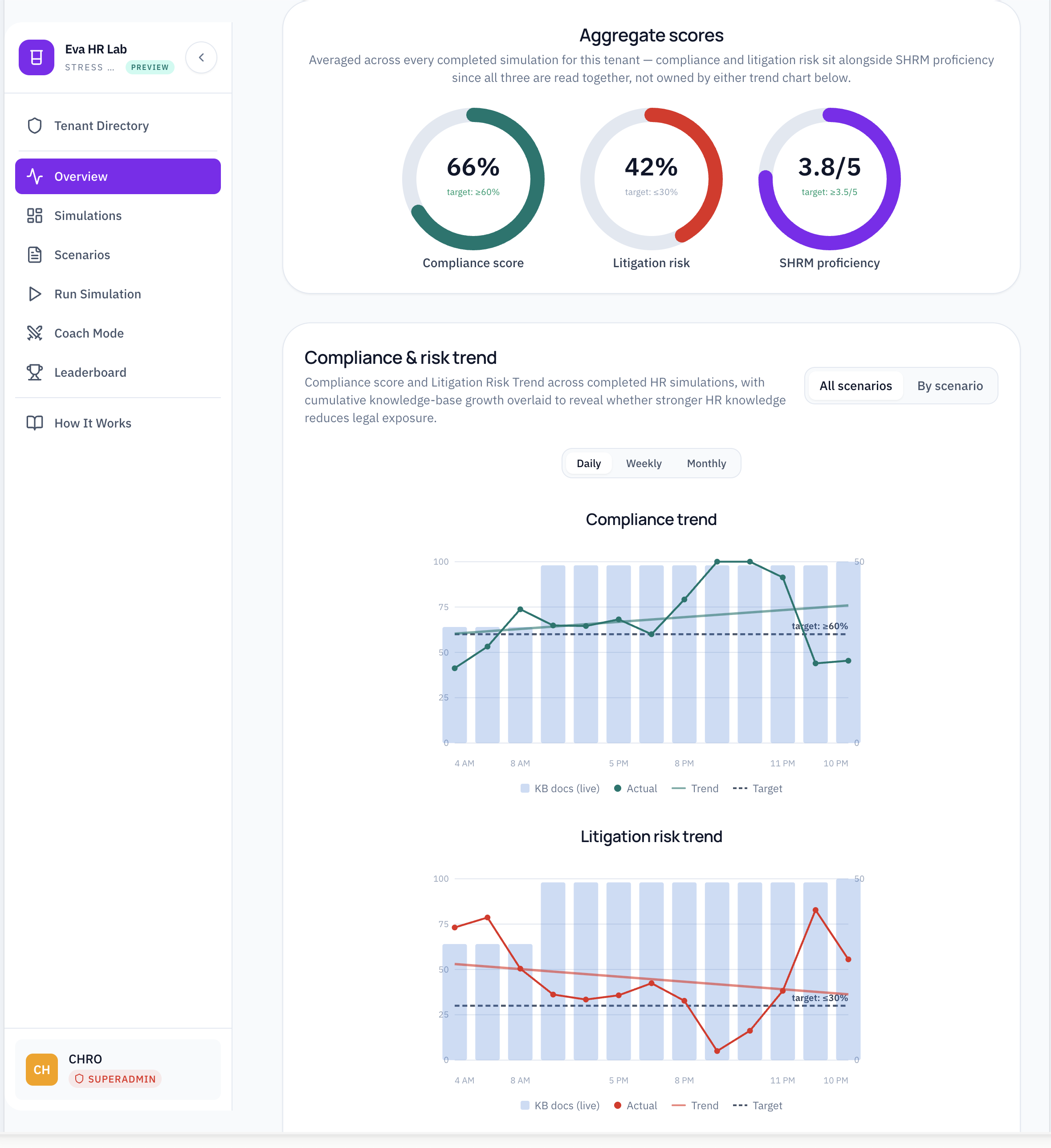
Eva HR Lab runs your organization through scenario-based simulations of the conversations that create litigation risk, and scores your team blind against Eva.

The EU AI Act's High-Risk Rules for HR AI Are Now in Force
The EU AI Act's high-risk obligations for employment AI are now active. Here's what changed for hiring, promotion, and monitoring tools, and what HR needs to check first.
See how Eva's source-grounded answers, access controls, and audit logging support governed HR communication.
Visit the Trust Center