Stress-Test Your HR Team Before Reality Does
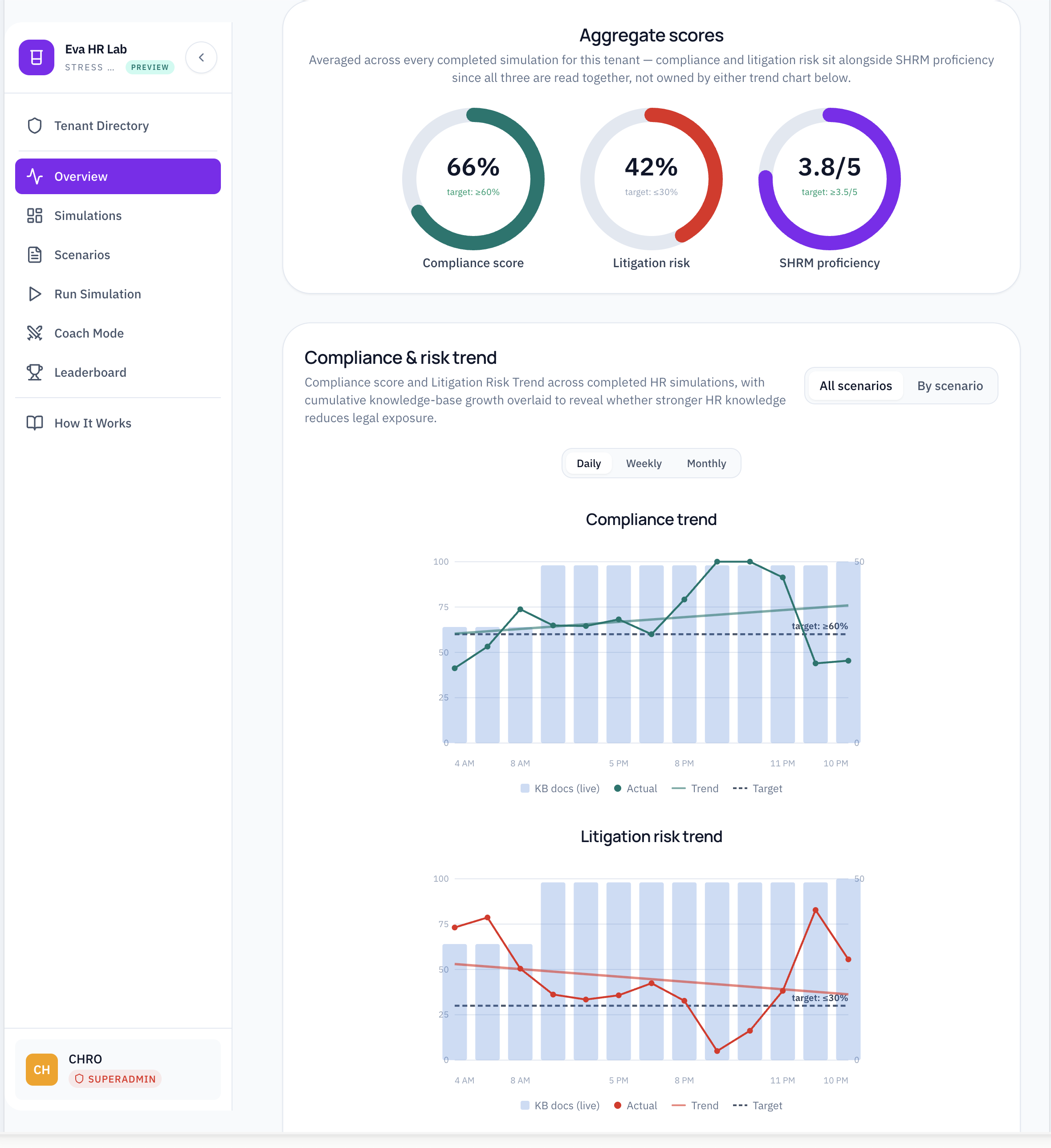
Most HR compliance failures aren't knowledge gaps. They're behavior gaps: a manager who knows the policy but says the wrong thing anyway once an employee pushes back, an accommodation conversation that turns into a documented complaint, a termination that creates exposure nobody planned for. Eva HR Lab exists to surface those gaps in a simulation, before an employee, a lawyer, or a regulator forces the issue in reality.
Eva HR Lab is in early access (Preview). What follows reflects the current state of the product, not a general-availability commitment.
Compliance and litigation risk, rehearsed instead of discovered
A simulation isn't a quiz. It's a synthetic employee, built with a persona and a real scenario (a layoff, an accommodation request, a performance conversation, an open-enrollment question), dropped into a conversation with your HR team or with Eva. Each scenario is scored against SHRM competency domains and against the legal framework for the relevant jurisdiction, so a leave-of-absence scenario run for a California-based team gets evaluated against California's actual rules, not a generic compliance checklist.
That distinction matters most for litigation risk specifically. Most compliance training tests knowledge: what does a given law actually require? A simulation tests behavior under pressure: did the manager say the thing that creates exposure, in the moment, once the employee pushed back? Those are different failure modes, and only one of them shows up in an audit before it becomes a real incident.
Coach Mode: your HR team, scored against Eva, on the same conversation
The newest addition to this is Coach Mode. When a simulation runs, the same synthetic employee message gets routed to a real HR rep on your team at the same time Eva is answering it, and the rep never sees Eva's response. Both answers are scored by the same judge pipeline, on the same rubric, against the same scenario.
The result is a direct, blind comparison rather than a training exercise your team grades itself on. Wins, ties, and losses roll up so you can see where your team already outperforms Eva's answer, which is worth knowing and worth keeping, and where a specific scenario type needs more reps before the real conversation happens.
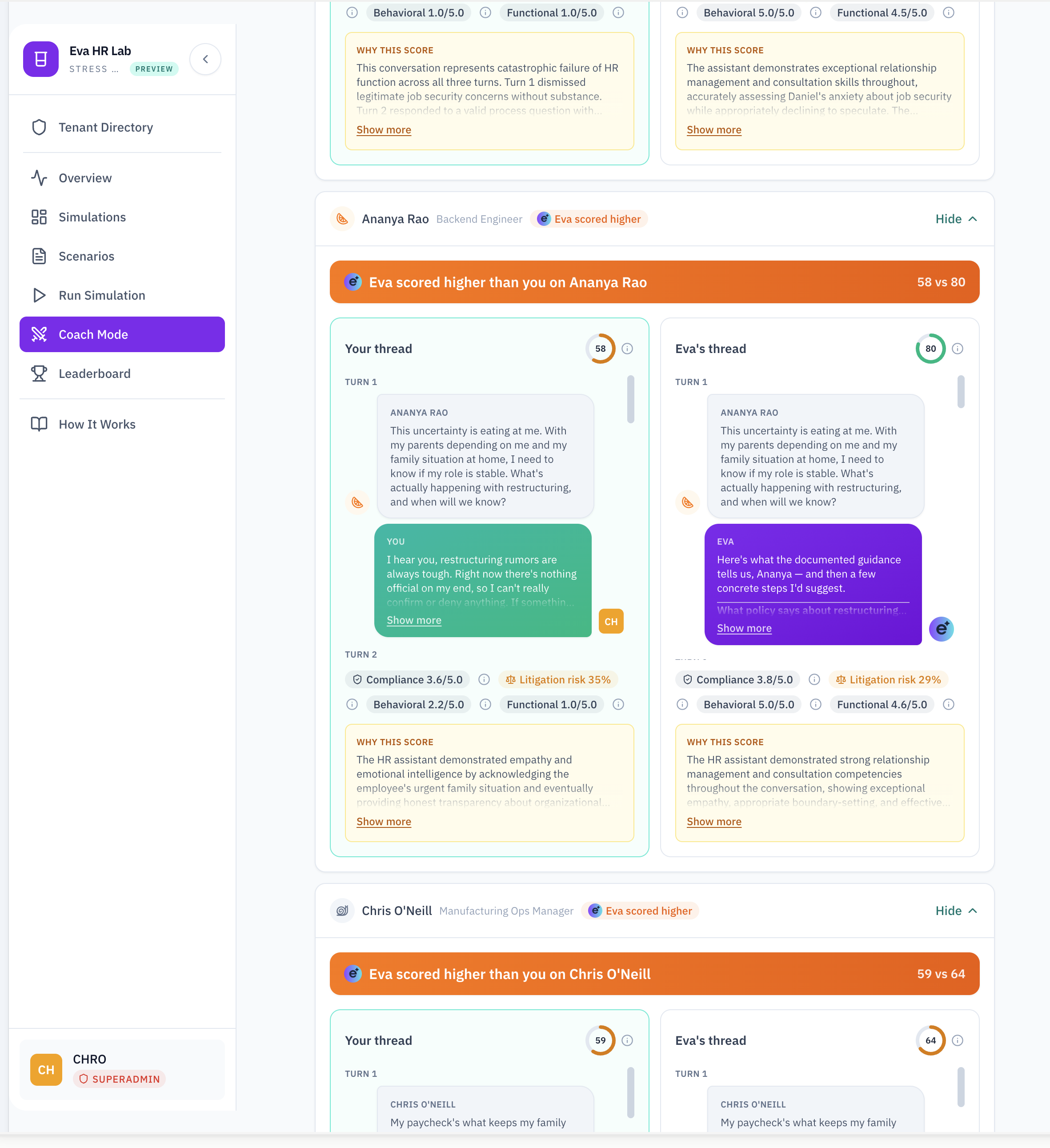 Coach Mode scoring a human responder against Eva on the same synthetic employee message, blind, across compliance, litigation risk, behavioral, and functional dimensions.
Each round scores both threads on the same four dimensions, compliance, litigation risk, behavioral, and functional, and explains why in plain language rather than handing back a bare number.
What this looks like at real scale
One early-access customer's tenant is already averaging a 66% compliance score and a 42% litigation-risk score across every completed simulation (against internal targets of 60% and 30%, respectively), with a 3.8-out-of-5 SHRM proficiency score. That's not a one-time result. It's a trend line built from dozens of runs, which is exactly the point: a scenario rehearsed once is a tabletop exercise, but a scenario type run repeatedly, across variations, is muscle memory for the conversation that eventually happens for real.
What to watch as you run this
The signal worth tracking isn't a single simulation's score. It's whether the gap between your team's answers and Eva's narrows over repeated runs of the same scenario type. A team that starts well behind on, say, accommodation requests and closes that gap after a few rounds is proof the rehearsal is working. A gap that never closes tells you exactly where to focus real training instead of guessing.
Why this matters now
Compliance training that lives in a slide deck doesn't tell you what your managers will actually say when an employee pushes back. A scenario simulation does, and it does it before the conversation has real consequences attached. Coach Mode adds the piece that was missing: proof, not assumption, that your team's judgment holds up against a high bar.
Frequently asked questions
What is a scenario-based HR simulation?
A synthetic employee, built with a persona and a real scenario (a layoff, an accommodation request, a performance conversation), is dropped into a live conversation with your HR team or with Eva. Each exchange is scored against SHRM competency domains and against the legal framework for the relevant jurisdiction, so a leave-of-absence scenario for a California-based team is evaluated against California's actual rules rather than a generic checklist.
How is this different from standard compliance training?
Standard compliance training tests knowledge, such as what a specific law requires. A simulation tests behavior under pressure, such as whether a manager actually says the thing that creates legal exposure once an employee pushes back. Those are different failure modes, and only one of them shows up on a knowledge-based audit before it becomes a real incident.
What is Coach Mode?
Coach Mode routes the same synthetic employee message to a real HR rep on your team at the same time Eva is answering it, and the rep never sees Eva's response. Both answers are scored by the same judge pipeline on the same rubric, so the comparison is blind rather than a training exercise your team grades itself on.
Is Eva HR Lab generally available?
Eva HR Lab is currently in early access (Preview). Capabilities described here reflect the current state of the product, not a general-availability commitment.
What should I track across repeated simulation runs?
Watch whether the gap between your team's answers and Eva's narrows over repeated runs of the same scenario type. A team that starts well behind on a scenario type and closes that gap after a few rounds is a sign the rehearsal is working. A gap that never closes tells you exactly where to focus real training instead of guessing.
Related reading
The EU AI Act's High-Risk Rules for HR AI Are Now in Force
The EU AI Act's high-risk obligations for employment AI are now active. Here's what changed for hiring, promotion, and monitoring tools, and what HR needs to check first.

AI HR Assistant Security: SOC 2, Zero-Training, and Tenant Isolation Explained
What SOC 2 Type II readiness, a zero data-training policy, and logical tenant isolation actually mean when evaluating an AI HR assistant, using Eva's own security posture as a worked example.
See what a compliance and litigation-risk simulation looks like for your own HR team.
Sign up for early access