AI Literacy Isn't Optional for HR Anymore: A Practical Guide

Eighty-three percent of employees say they want to learn more about AI, and employers estimate that roughly 40% of existing job tasks will be automated or significantly augmented by AI within two years. Most AI literacy training built in response to that, though, is written for the general workforce — not for the HR team that's supposed to roll it out, govern it, and answer questions about it.
What AI literacy actually means
AI literacy isn't "can you open ChatGPT and get a decent answer." It's a specific set of habits: knowing how to verify an AI-generated output before it goes into a policy or a candidate communication, knowing what employee data should never touch a public AI tool, and knowing how AI capabilities map onto your actual day-to-day tasks rather than generic examples. It also includes an ethical layer — recognizing where bias, privacy, or compliance risk shows up in an AI-assisted decision.
Why HR is usually the last team to get trained
L&D functions typically build AI literacy programs for the broader employee population first, on the assumption that HR — the team designing the training — already has this covered. That assumption doesn't hold up well: a large share of organizations haven't deployed any AI inside the HR function itself, even as CHRO expectations for AI adoption keep climbing. The gap isn't ambition, it's practiced fluency.
A practical starting point
Skip the org-wide AI curriculum and start narrower:
- Pick one workflow. A single, high-volume, low-risk use case — like answering benefits or PTO questions — makes the training concrete instead of theoretical.
- Pair training with a sanctioned tool. Teaching verification habits in the abstract doesn't stick if the only AI tool people have access to is an unapproved public one.
- Define what "good enough to ship" looks like. For an HR-facing answer, that means citing the actual policy document, not just sounding confident.
- Measure real usage, not completion of a training module. Literacy shows up in behavior, not in a quiz score.
Where this shows up in practice
An AI assistant built specifically for HR questions — one that answers from your actual policy documents rather than a generic model, and that HR can audit — gives a team something concrete to build literacy around, instead of trying to teach AI judgment against a blank page. See the full feature set this kind of assistant needs to be trustworthy enough to build that literacy on.
Sources
Frequently asked questions
What does "AI literacy" mean for HR specifically?
It's not the same as knowing how to use ChatGPT. AI literacy for HR covers how to verify AI-generated outputs before acting on them, what employee data should never be shared with a public AI tool, and how AI applies to role-specific tasks like drafting policy language or triaging benefits questions.
Why is HR often the last team trained on AI, even though it should be first?
L&D teams tend to build AI training for the broader workforce before circling back to HR itself, on the assumption HR already understands the tools it's rolling out. In practice, over half of organizations haven't implemented any AI in HR yet, so that assumption usually isn't true.
What's a realistic first AI workflow for an HR team to practice on?
Pick one narrow, high-volume, low-risk workflow, such as answering repetitive benefits or PTO questions, rather than trying to train the whole function on AI generally. A single concrete workflow makes verification habits and data-handling rules concrete instead of abstract.
How does AI literacy training reduce shadow AI use?
When employees, including HR staff, understand what a sanctioned AI tool can do and are given one that actually works, they have far less reason to reach for an unapproved public tool. Providing an approved option is consistently shown to cut unauthorized AI use dramatically.
Related reading
Stress-Test Your HR Team Before Reality Does
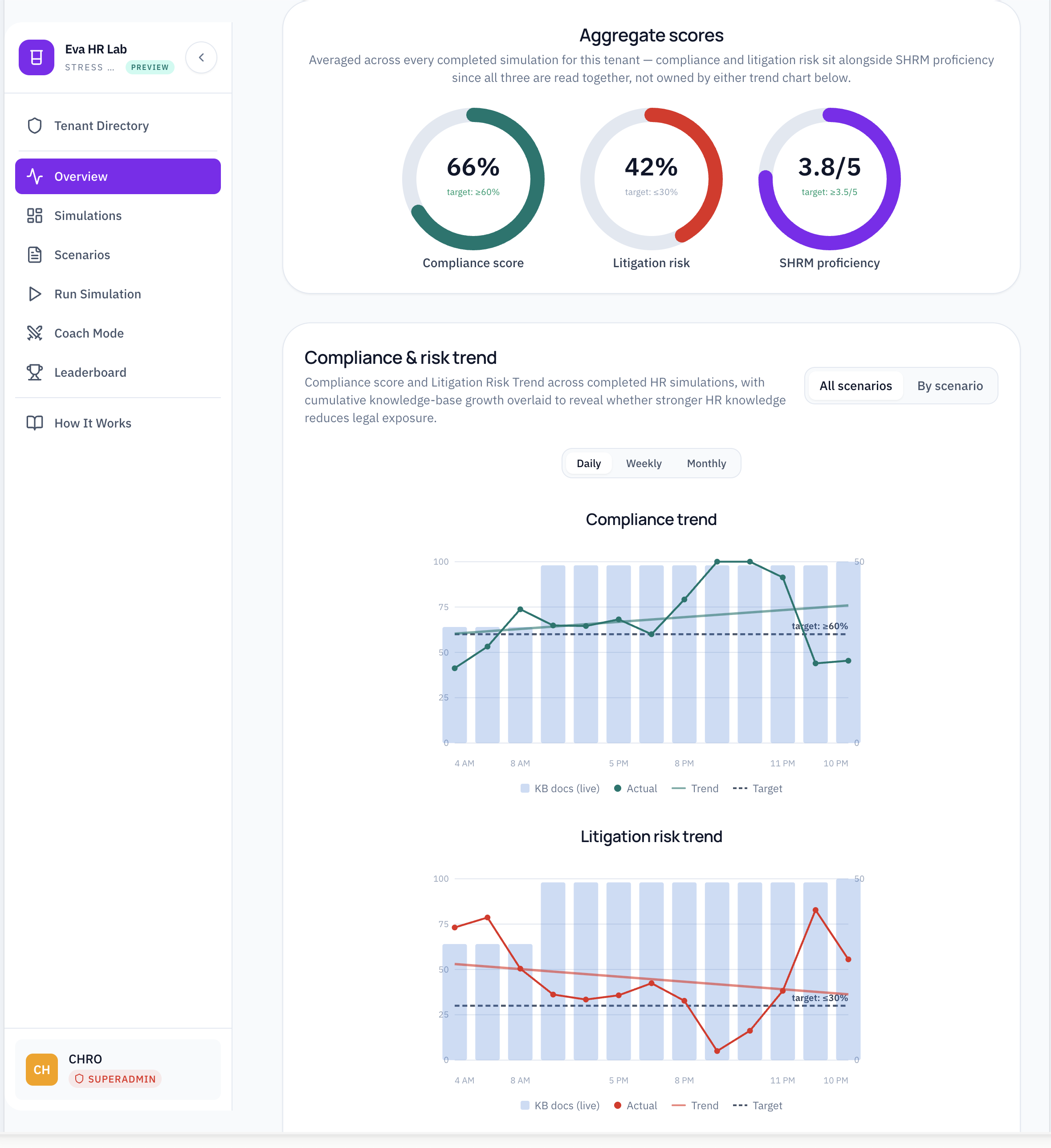
Eva HR Lab runs your organization through scenario-based simulations of the conversations that create litigation risk, and scores your team blind against Eva.

The EU AI Act's High-Risk Rules for HR AI Are Now in Force
The EU AI Act's high-risk obligations for employment AI are now active. Here's what changed for hiring, promotion, and monitoring tools, and what HR needs to check first.
See how Eva helps HR teams put AI into practice safely.
Explore Eva People