How to Reduce HR Ticket Volume with AI Automation

The fastest way to reduce HR ticket volume is to automate the routine, repetitive questions that make up most of it — benefits, PTO, payroll, and policy questions — so employees get instant, accurate answers without opening a ticket at all. Organizations using Eva by Vistry see an average 22% reduction in HR tickets, with up to 85% of routine queries resolved autonomously.
Why most HR ticket volume is avoidable
Most HR tickets aren't complex — they're the same handful of questions asked over and over: "How much PTO do I have left?" "When does open enrollment end?" "What's the parental leave policy?" Every one of those requires an HR team member to look something up and repeat an answer that's already written down somewhere. That's the volume an AI assistant can absorb directly, answering from your organization's actual policy documents rather than a generic script.
What results look like in practice
See the full detail behind these numbers in Eva's case studies.
- Envu (specialty chemicals/agriculture): 22% reduction in HR tickets, 95% retrieval accuracy.
- Circuit of The Americas: 21 hours saved per week, deployed in under 2 weeks, supporting 10,000 staff and 450,000 visitors during a Formula 1 event.
- A specialty chemicals company automated 67% of HR inquiries with a 95% first-response accuracy rate.
What it takes to get there
Reducing ticket volume with AI comes down to three things: connecting the assistant to your existing HR documents and systems (HRIS, SharePoint, policy wikis) so it answers from real policy rather than guessing; making it available where employees already work (Teams, Slack, web); and giving HR visibility into what's actually being asked, so gaps in documentation get fixed at the source instead of generating the same ticket every week. This is the core of what streamlined HR operations looks like in practice.
Frequently asked questions
What actually reduces HR ticket volume?
The biggest driver is automating the routine, repetitive questions that make up most HR ticket volume: benefits, PTO, payroll, and policy questions. Eva resolves these autonomously, at up to 85% of routine query volume, instead of routing every question to an HR team member.
How much can AI automation realistically reduce HR tickets?
Across Eva's customer base, HR ticket volume has dropped by an average of 22%. Envu, a specialty chemicals and agriculture company, saw a 22% reduction in HR tickets with 95% retrieval accuracy after deploying Eva.
Does this only work for simple FAQ-style questions?
No. Eva answers complex, document-grounded HR questions (benefits eligibility, policy exceptions, payroll timing) with 95% accuracy by drawing directly from your organization's actual policies, not a generic knowledge base, and escalates only what genuinely needs a human.
How long does it take to see a reduction in ticket volume?
Eva can be implemented in as little as two weeks. Circuit of The Americas deployed Eva under two weeks for their Formula 1 event and handled 845 employee queries with 24/7 multilingual support across a 450,000-visitor event.
What does automating HR tickets free up for the HR team?
Organizations using Eva report 21+ hours saved per week for HR teams and estimated annual savings of $150K+ for mid-size enterprises, time and budget that shifts from answering repeat questions to strategic HR work.
Related reading
Stress-Test Your HR Team Before Reality Does
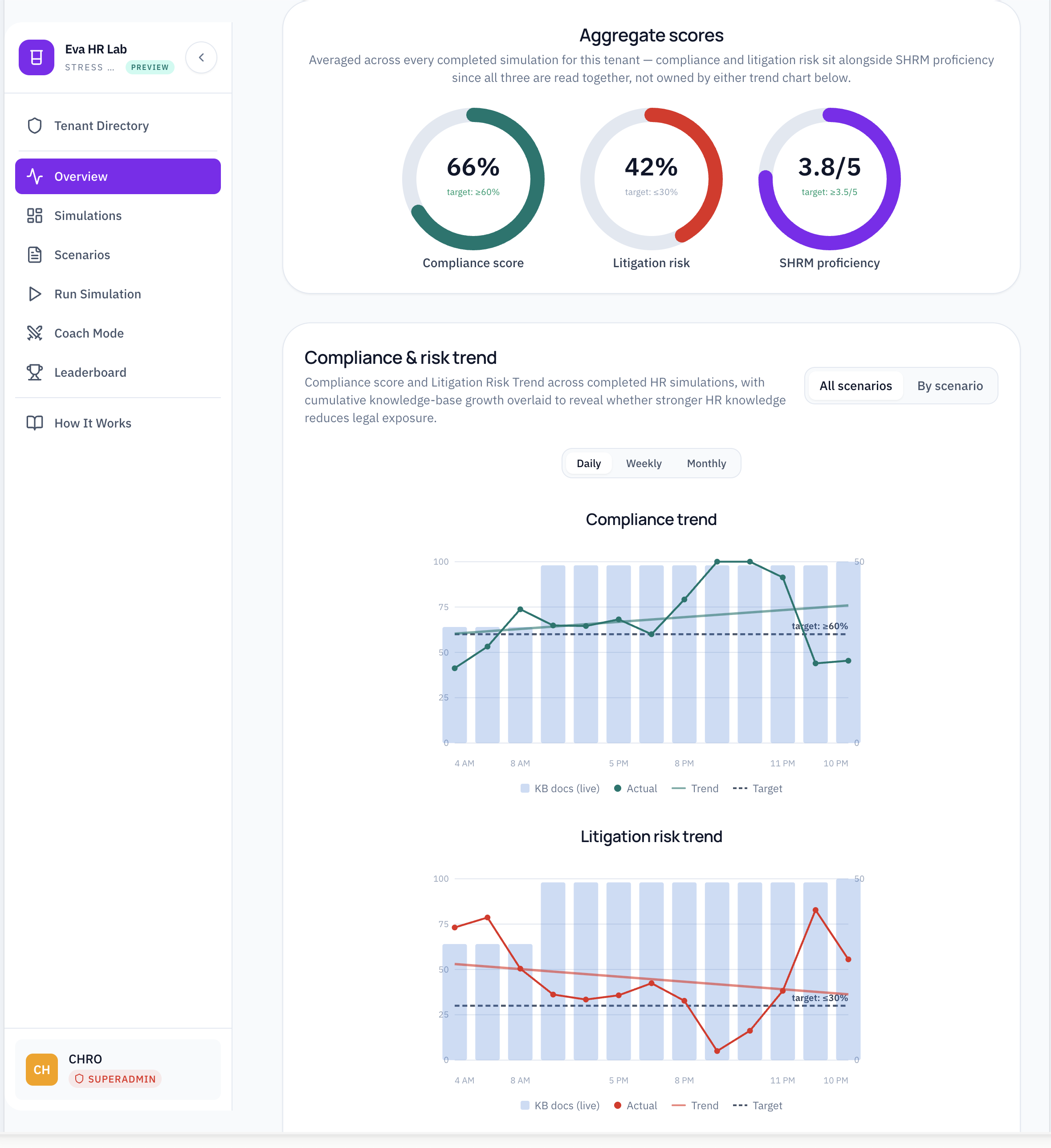
Eva HR Lab runs your organization through scenario-based simulations of the conversations that create litigation risk, and scores your team blind against Eva.

The $5-to-$1 Rule: What McKinsey's ROI Math Means for Your AI Business Case
McKinsey's finding that companies should invest $5 in people for every $1 spent on AI technology, and what that ratio should actually change in your AI HR business case.
See how much Eva could reduce your own ticket volume.
Build your business case