The Legal Exposure Hiding in Your Team's AI Habits

Thirty-eight percent of employees admit to sharing sensitive work information with an AI tool without their employer's permission. Separately, only 23% of the actual AI usage inside a typical organization is visible to leadership, even though 78% of executives believe they have a clear picture of it. That gap between what leadership assumes and what's actually happening is where the legal exposure lives.
Where the exposure actually comes from
It breaks down into four buckets, and HR sits at the intersection of all of them:
- Data privacy violations — employee PII, health information, or performance data entered into a public AI tool that wasn't vetted for that purpose.
- Trade secret leakage — internal compensation bands, restructuring plans, or policy drafts exposed through a free-tier AI account with no enterprise data agreement.
- Copyright and IP issues — AI-generated content used in official employee communications without review.
- Discrimination and bias claims — any AI-influenced decision touching hiring, promotion, or pay that can't be explained or traced back to a defensible source.
That last category is the one that scales fastest into real legal risk, because HR decisions are exactly the kind regulators and plaintiffs' attorneys already scrutinize.
Why blanket bans don't fix it
Banning AI tools outright is a common first reaction, and it consistently fails, because employees adopt shadow AI tools for a simple reason: they deliver measurable productivity gains that sanctioned procurement cycles can't match. Take the tool away without replacing the need and usage just moves further out of sight. The intervention that actually works is providing an approved tool capable enough that people stop reaching for the unapproved one — that alone has been shown to cut unauthorized AI use dramatically.
What generic AI policy misses for HR specifically
Most enterprise AI governance policies are written for marketing, engineering, or general productivity use cases. They rarely address the categories of employee data that carry extra legal weight, the audit-trail requirements for any decision touching pay or employment status, or the fact that an AI-assisted HR decision can trigger EEOC-relevant scrutiny in a way other departments' AI use never will. This is exactly the gap IT and security teams need to close before HR AI goes into production.
A short checklist before HR touches AI in production
- Where is the data stored, and does the vendor contractually agree not to train models on it?
- Can every AI-generated answer be traced to a specific source document?
- Is access scoped by role, matching your existing HR permission structure?
- Is there a human escalation path for anything touching pay, discipline, or employment status?
Getting these answered before rollout is far cheaper than answering them during discovery.
Sources
Frequently asked questions
What kind of legal exposure comes from unsanctioned AI use in HR?
Four main categories: data privacy violations (employee PII entered into a public AI tool), trade secret leakage (internal policy or compensation data exposed), copyright issues (AI-generated content used in official communications), and discrimination claims (AI-influenced decisions that can't be explained or audited).
Why don't blanket bans on AI tools solve the problem?
Employees adopt unsanctioned AI tools because they deliver real, immediate productivity gains that sanctioned procurement can't match on speed. Banning access without replacing the need just pushes usage further out of view. Providing an approved, capable alternative is what actually reduces unauthorized use.
What does HR-specific AI governance need that a general IT AI policy misses?
General IT AI policies rarely account for protected employee data categories, the audit-trail requirements around decisions that affect pay or employment status, or the fact that an AI-influenced HR decision can trigger EEOC-relevant scrutiny in a way a marketing AI tool never will.
What should we check before rolling out any AI in an HR workflow?
Where the underlying data is stored and who can access it, whether the vendor trains its models on your data, whether every AI-assisted answer or decision can be traced back to a source, and whether the tool has role-based access control matching your existing HR permissions.
Related reading
Stress-Test Your HR Team Before Reality Does
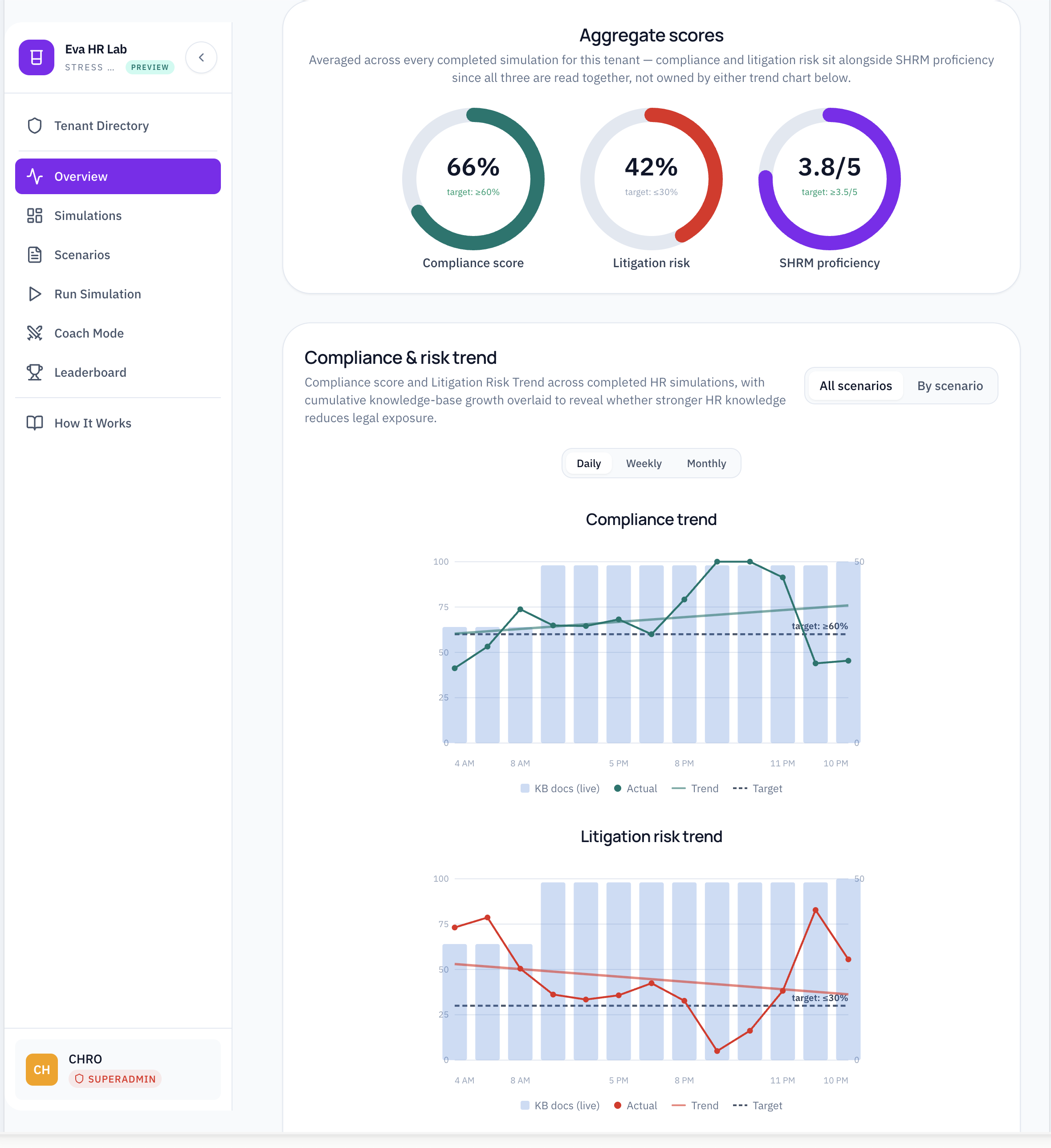
Eva HR Lab runs your organization through scenario-based simulations of the conversations that create litigation risk, and scores your team blind against Eva.

The EU AI Act's High-Risk Rules for HR AI Are Now in Force
The EU AI Act's high-risk obligations for employment AI are now active. Here's what changed for hiring, promotion, and monitoring tools, and what HR needs to check first.
See Eva's tenant isolation, encryption, and audit logging in detail.
Visit the Trust Center